

François-Auguste Biard is best known for his vivid paintings of distant lands and cultures. Born in Lyon, France, in 1799, Biard set out to join the clergy but soon discovered his calling as an artist. After studying at the École des Beaux-Arts in Paris, he traveled through Italy, Greece, Egypt, and the Middle East, broadening his artistic horizons. However, it was his time in Brazil and North America that shaped some of his most powerful and socially conscious works, particularly those addressing the brutal realities of slavery.
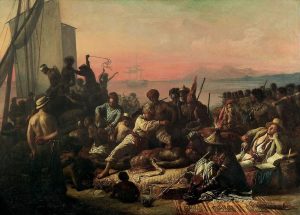
The Slave Trade is one of Biard’s most significant and unsettling creations. On the deck of a slave ship, men, women, and children are chained, their faces etched with fear and despair. Some of these prisoners kneel in submission; others stand rigidly, packed into an oppressive, confined space. Biard’s potent use of light and shadow and his muted, somber palette amplify the sense of suffering, adding emotional weight to the devastating scene.
At the heart of the composition, two white slave traders inspect a young man lying helplessly on his back. Nearby, another man brands a female slave, a chilling act of dehumanization. In the foreground, a weary African slave dealer puffs on a long pipe, while a white trader lounges behind him, indifferent. To the left, other slaves are whipped and loaded onto the ship, their bodies contorted in agony. A white dealer stands in the foreground, his back to the viewer, holding a restraining device, one of the violent tricks of the trade.
In 1862, Biard published Deux années au Brésil (Two Years in Brazil), a travelogue illustrated with 180 engravings. Shedding light on the horrors of slavery, this volume contributed to a growing awareness of the social injustices involved.
Biard’s artistic legacy is thus not just one of adventure and discovery, but of conscience, making The Slave Trade an important and poignant part of his ouevre
Feel free to share


Issues 51-100
No image assigned to this category.