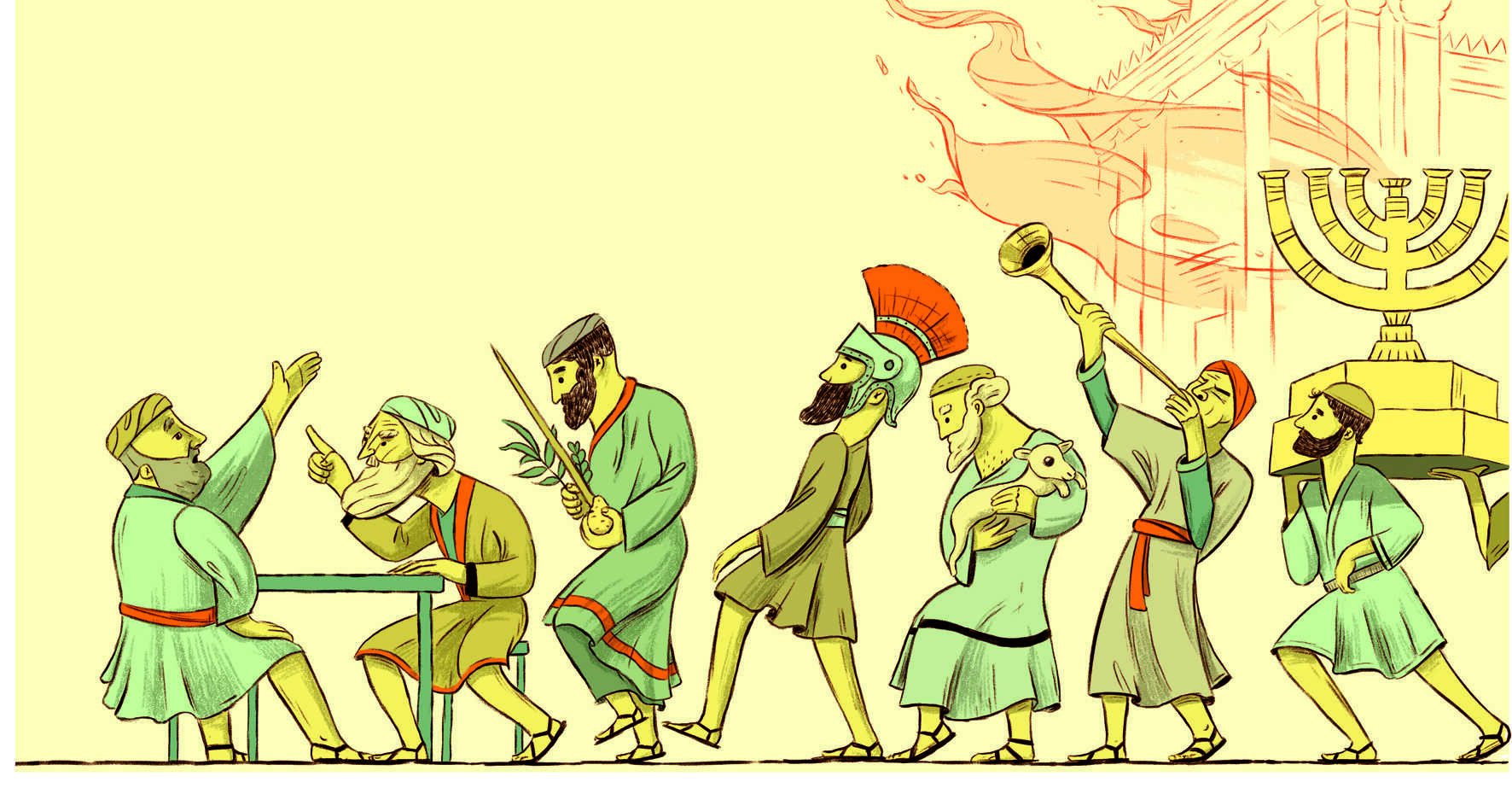
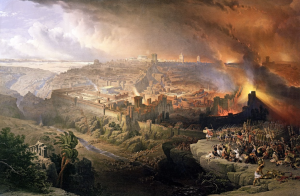
Rabbinic Judaism is often described as having developed in reaction to the loss of the Temple and its sacrificial ritual. Certainly, the sages of the period were responding to some kind of crisis. But was it the physical destruction of Jerusalem or something more subtle?

Out of the crisis caused by the destruction of the Second Temple in 70 CE, a new Judaism is generally thought to have arisen, molded by the rabbinic sages over subsequent generations. These scholars expanded Jewish law’s horizons and deepened its intellectual underpinnings. Along with creating exegetical methods and educational models, the rabbis founded institutions of learning to replace those centered on Jerusalem and the Temple service. These schools in turn developed new literary genres, including legal codes such as the Mishnah and the homilies loosely termed Midrash.
A new leadership model also emerged, with a council of sages and a nasi (patriarch) replacing the defunct priesthood and faltering Herodian royalty. In an age of subjugation and persecution, the rabbis redefined Jewish identity and even God Himself and His relationship with the people of Israel. These far-reaching changes echo in the layers of Talmudic literature formulated after the loss of the Temple, resulting in a Judaism in which the memory of the Temple service was preserved yet marginalized.
A key figure in this transformation was Rabbi Yohanan ben Zakkai, who escaped besieged Jerusalem in the throes of the Great Revolt. According to later traditions, Rabbi Yohanan famously informed Vespasian of his impending promotion to Roman emperor and requested that Yavne – city of the sages – be spared to take Jerusalem’s place. Among other decrees, Ben Zakkai determined that commandments previously limited to the Temple – such as blowing the shofar and waving the four species on Sukkot – should continue everywhere. Filling the vacuum left by the destruction of the Temple, he ruled on Jewish rituals disconnected from the practice of daily sacrifices.
Torah Old and New
Many early rabbinic sources reflect a sense of crisis, of fear that the Torah would be forgotten in the wake of persecution and dispersion. For instance:
When the sages gathered in Kerem be-Yavne, they pronounced: “A time will come when people will seek […] words of Torah and not find, words of the scribes and not find […], and then no [version of] the words of Torah will resemble any other.” They resolved: “Let us start from Hillel and Shammai.” (Tosefta, Eduyot 1:1)
Not yet a Segula subscriber?
Access our full archive online, have print issues delivered to your door, and moreFeel free to share