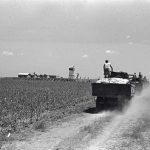

The dream of discovering a wealth of natural resources beneath the soil of the land of Israel is as old as the state itself. What actually happened when this dream briefly came true and hope burst from the ground of the Negev in a viscous, black stream?

Where To?
Heletz, historic oil-drilling site

Though Israel generally lurches from one crisis to another – whether war, scandal, or constitutional upheaval – moments of national rejoicing and pride occasionally unite the nation. Once in a while, an Olympic medal, obscenely profitable public company exit, or scientific achievement makes headlines worldwide, and we’re suddenly a benefit to mankind.
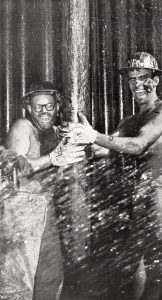
One such rarity occurred in the autumn of 1955, with the young State of Israel’s discovery of a promising oil field measuring 230 square kilometers among the southern sand dunes somewhere between Ashkelon, Sderot, and Kiryat Gat. As the country struggled to absorb roughly a million immigrants, newcomers were living in tents in transit camps, meat was available only on the black market, and terrorists attacked from every border. Morale was about as low as the Dead Sea, and though Ha-tikva was still the national anthem, hope was scarce.
Then, on the Friday before Yom Kippur, September 23, 1955, the radio newscaster announced in a voice choked with emotion that after years of dry drilling, Israeli oil exploration had finally struck gold.
The achievement was particularly thrilling in view of past failures, beginning with an American initiative launched under Ottoman rule back in 1914 but stymied by the outbreak of World War I. In 1933, the British Mandate authorities gave their blessing to another attempt after an extensive geological survey and preliminary exploration pointed to the Ashkelon coast. Once again, world war got in the way – this time combined with Arab rioting – and nothing came of the venture.
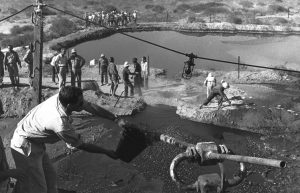
It was 1952 by the time the Israel Oil Exploration Co. was founded, backed by the Solel Boneh construction company. Based on the Mandate geological survey and previous drilling, Israel Oil joined forces with Lapidot (a subsidiary of the government water corporation to drill to a depth of 1.5 kilometers in various places. After a year and a half, the team had yet to strike oil – until early that Friday morning in 1955, when David Ben-Gurion, Finance Minister Levi Eshkol, and other VIPs turned up to make sure it really was oil spurting up from the ground in the abandoned Arab village of Huleiqat.
A Blessing on Your Head?
At 6:30 in the morning, the spigot was turned on, and a mighty, black jet squirted out so high onlookers gaped. Soaked, they were all wondering how to turn the thing off before everyone drowned in an oily sea. Fortunately, one of the workers, a new immigrant from Morocco named Shalom Azulai, managed to wade through the viscous lake and put the stopper back in place. He was rewarded with instant, everlasting fame when Eshkol shouted, “Give me your oily hand!” and shook it warmly in front of all the cameras.
Not yet a Segula subscriber?
Access our full archive online, have print issues delivered to your door, and moreFeel free to share